
A photogrammetry project turning everyday objects into cast forms and sound interfaces, developed during a residency in Madrid, 2021
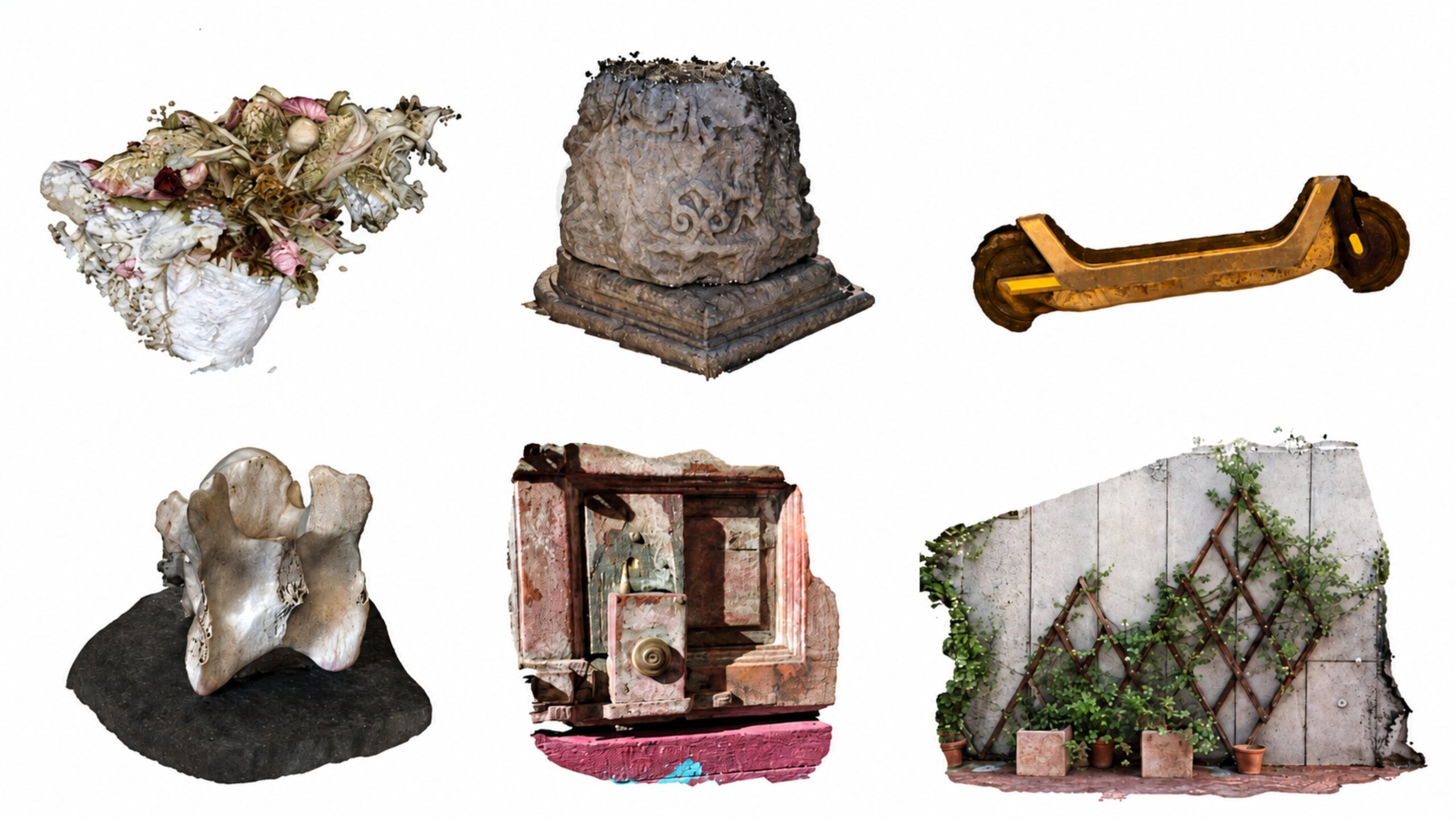
Photogrammetry models from the workshop and street scanning.
Project Description
Collage of Hybridities was developed during Po-Hao Chi’s residency at Medialab Prado in Madrid. Phone-based photogrammetry runs through several interconnected strands of the project: cast objects that function as interactive sound interfaces, a public photogrammetry workshop, and a public presentation at the end of the residency.
The process begins with capture and reconstruction. Everyday objects are photographed from multiple angles with a phone and reconstructed as 3D models through photogrammetry. The resulting models are then edited and simplified.
Photogrammetry records the object together with the conditions through which it is encountered. As the camera moves around the object, fragments of nearby surfaces, background structures, and surrounding textures enter the reconstruction. Gaps, torn surfaces, and uneven geometry register where the object could be seen, where movement was restricted, and where parts of the reconstruction remained incomplete. These traces are kept as part of the resulting form, allowing the model to carry something of the encounter through which it was produced.
The reconstructed models are then 3D printed and cast into physical objects. A contact microphone is embedded in each cast object, so that tapping, dragging, or scraping its surface can trigger fragments of image and sound recorded during the original encounter with the object. The remade object becomes a tangible interface through which those earlier moments can be recalled.
This connection between object, memory, and incompleteness echoes Susan Stewart’s writing on the souvenir, in which a partial object evokes a distanced experience and becomes a point from which its narratives continue to unfold. Collage of Hybridities extends this relation through scanning, digital reconstruction, rematerialization, and touch.
作品介紹
《混種拼貼》發展於紀柏豪 2021 年在西班牙馬德里 Medialab Prado 的駐村期間。手機攝影測量(photogrammetry)貫穿計畫中幾項彼此相關的實驗,包括作為互動聲音介面的翻模物件、一場公開攝影測量工作坊,以及駐村結束時的公開成果發表。
作品從拍攝與重建開始。日常物件先以手機從不同角度拍攝,透過攝影測量重建為 3D 模型,再進行編修與簡化。
攝影測量記錄了物件,也記錄人如何接近、觀看與環繞它的條件。當相機沿著物件移動時,周遭的表面、背景結構與環境紋理也會部分進入重建結果。模型中的孔洞、破面與不均整的幾何,留下哪些位置曾經被看見、哪些地方受到移動條件限制,以及哪些部分沒有被完整重建。這些痕跡被保留在最後的形態之中,使模型也帶著它被觀看與掃描時所經歷的過程。
重建後的模型再經由 3D 列印與翻模重新成為實體。翻模物件中被安裝了接觸式麥克風,當輕敲、拖曳或刮擦表面時,可以觸發當初與物件相遇時所記錄的影像與聲音片段。重新製作的物件因此成為一種可觸碰的介面,讓過去與物件及其所在環境相遇的片段再次被喚起。
這種物件、記憶與不完整性之間的關係,也呼應 Susan Stewart 對「紀念品」的討論:局部的物件指向一段已經遠離的經驗,並成為記憶與敘事持續展開的起點。《混種拼貼》則進一步將這種關係延伸到掃描、數位重建、重新物質化與觸碰之間。
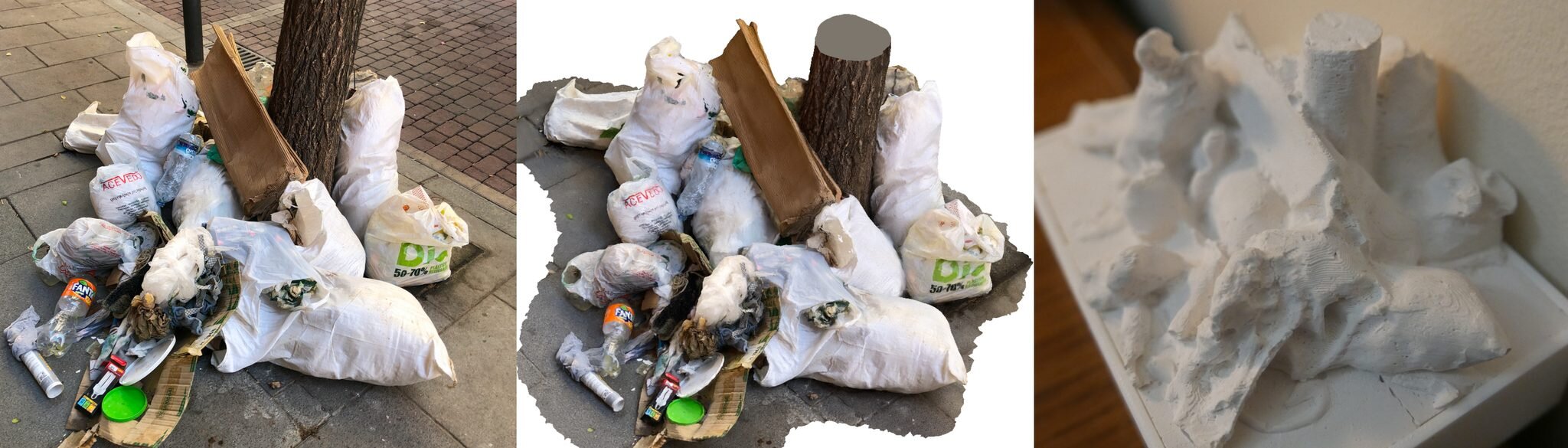
Discarded street objects: as found, as a textured model, and as a bare mesh.
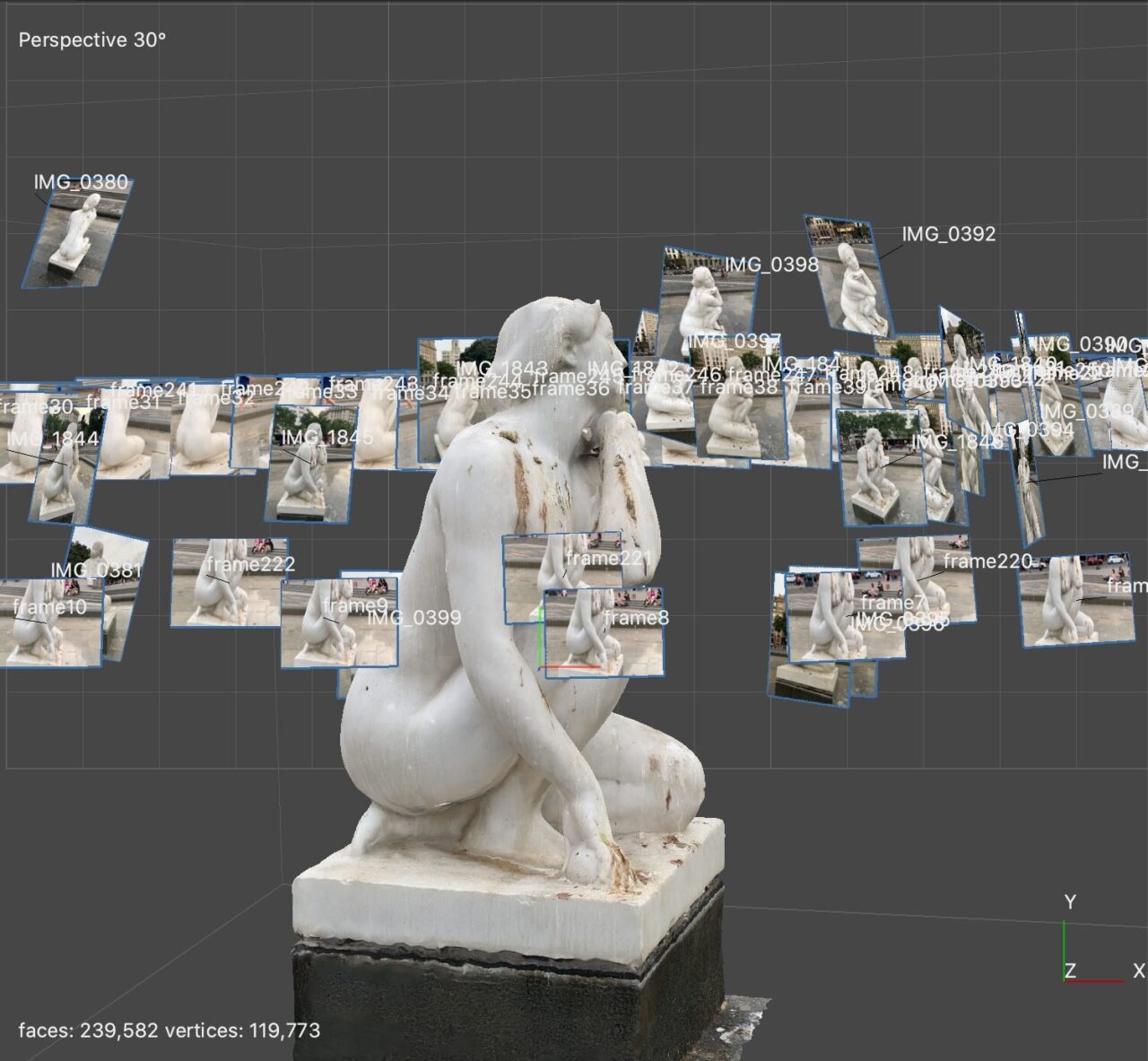
The figure model: a statue in a public square, reconstructed in Agisoft Metashape. Each thumbnail marks where a source image was taken.
Making the Objects 物件的生成
-
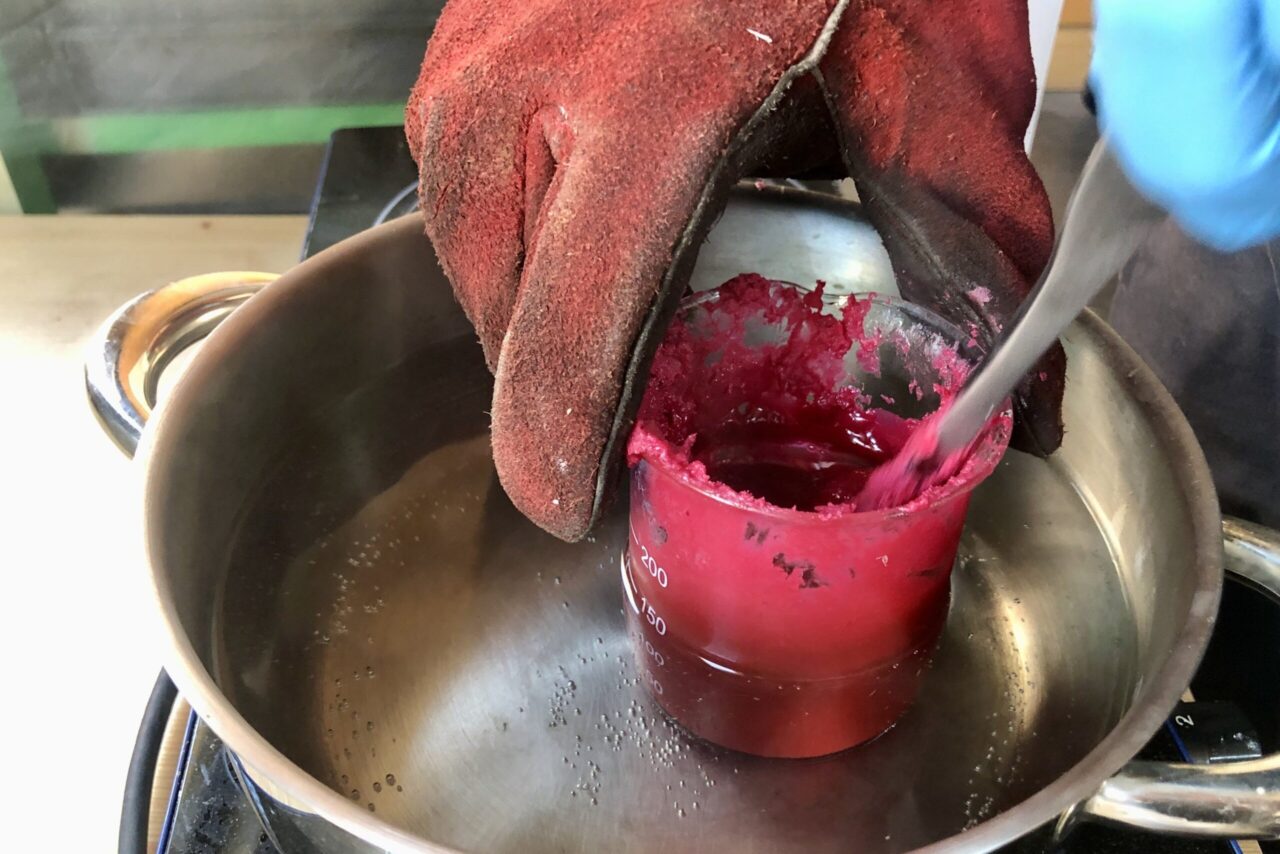
- Melting wax in a water bath for casting.
-
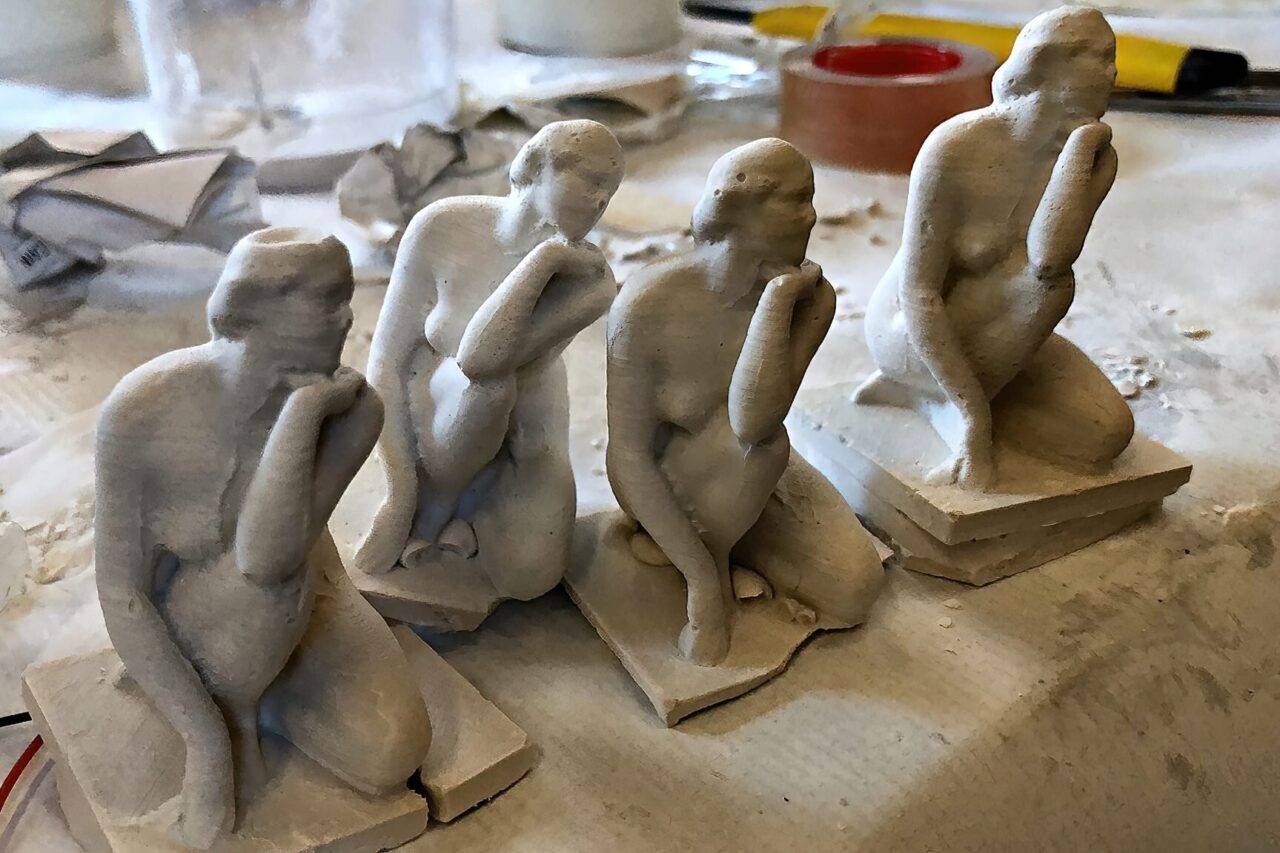
- Figure casts, still rough from the mold.
Scanning was carried out with ordinary smartphones and processed in Agisoft Metashape: aligning photographs, building sparse and dense point clouds, generating a mesh, and calculating a texture. The resulting models were exported as glb and stl files, printed as shells on a Prusa i3, then used to make silicone molds for casting in plaster and wax at the Medialab Prado FabLab.
掃描使用一般智慧型手機拍攝,並匯入 Agisoft Metashape 進行運算:對齊照片、建立稀疏與密集點雲、生成網格,再計算貼圖。完成的 3D 模型輸出為 glb 與 stl 格式,在 Medialab Prado FabLab 使用 Prusa i3 列印成殼,再翻製矽膠模,灌注石膏與蠟成為實體。
-
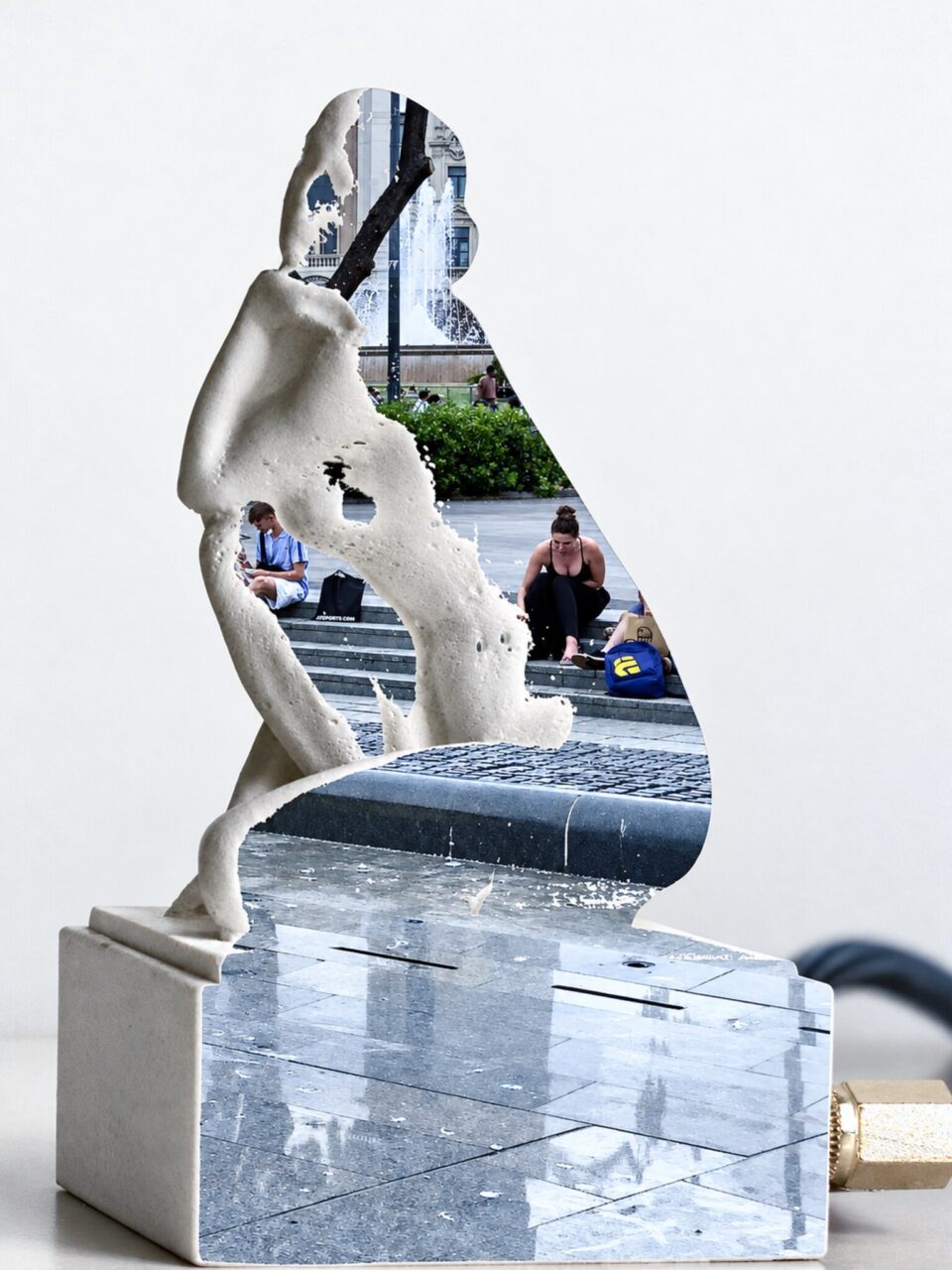
- The figure model, composited with a street photograph.
-
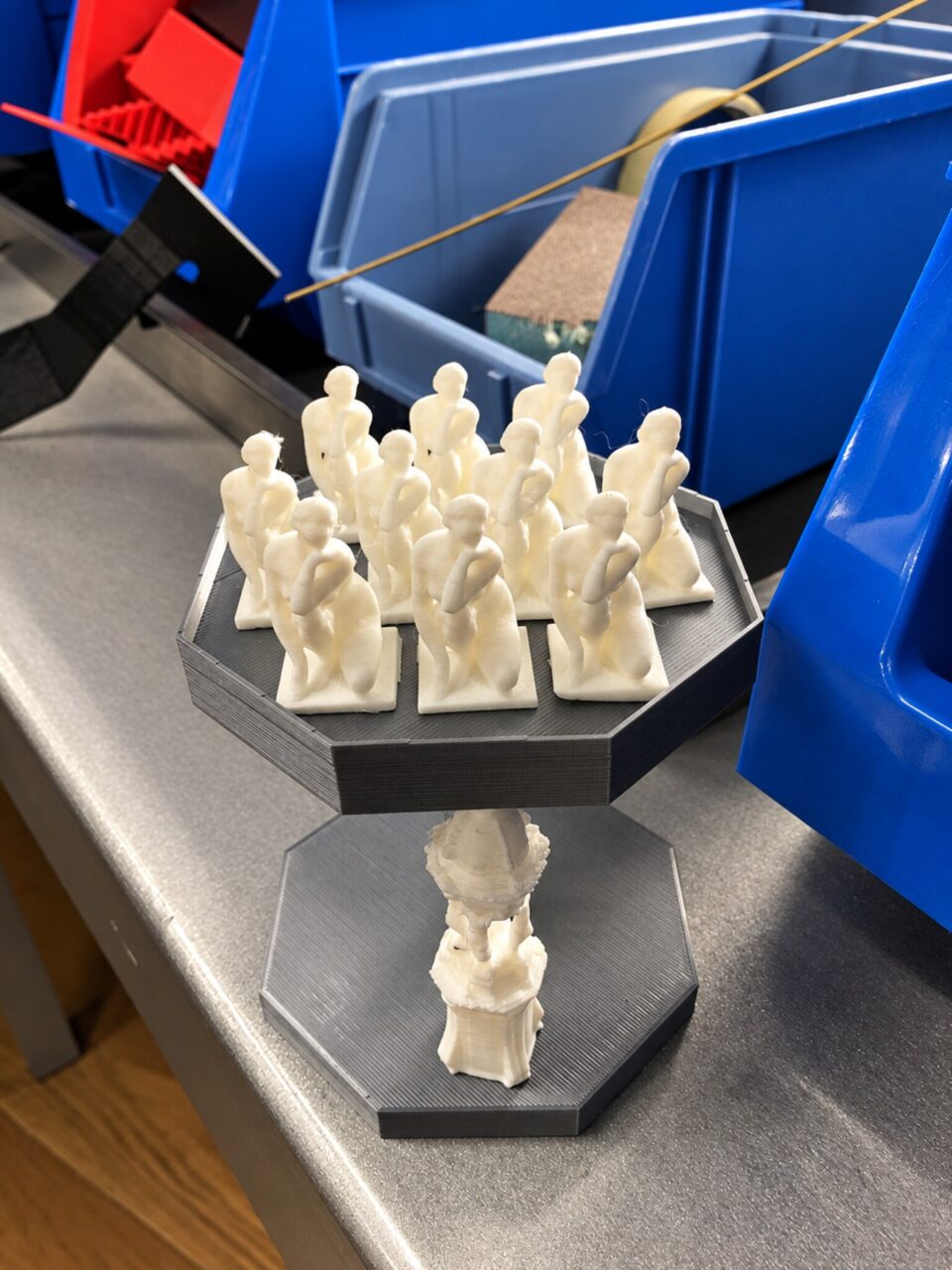
- 3D prints of the figure on an octagonal stand.
-
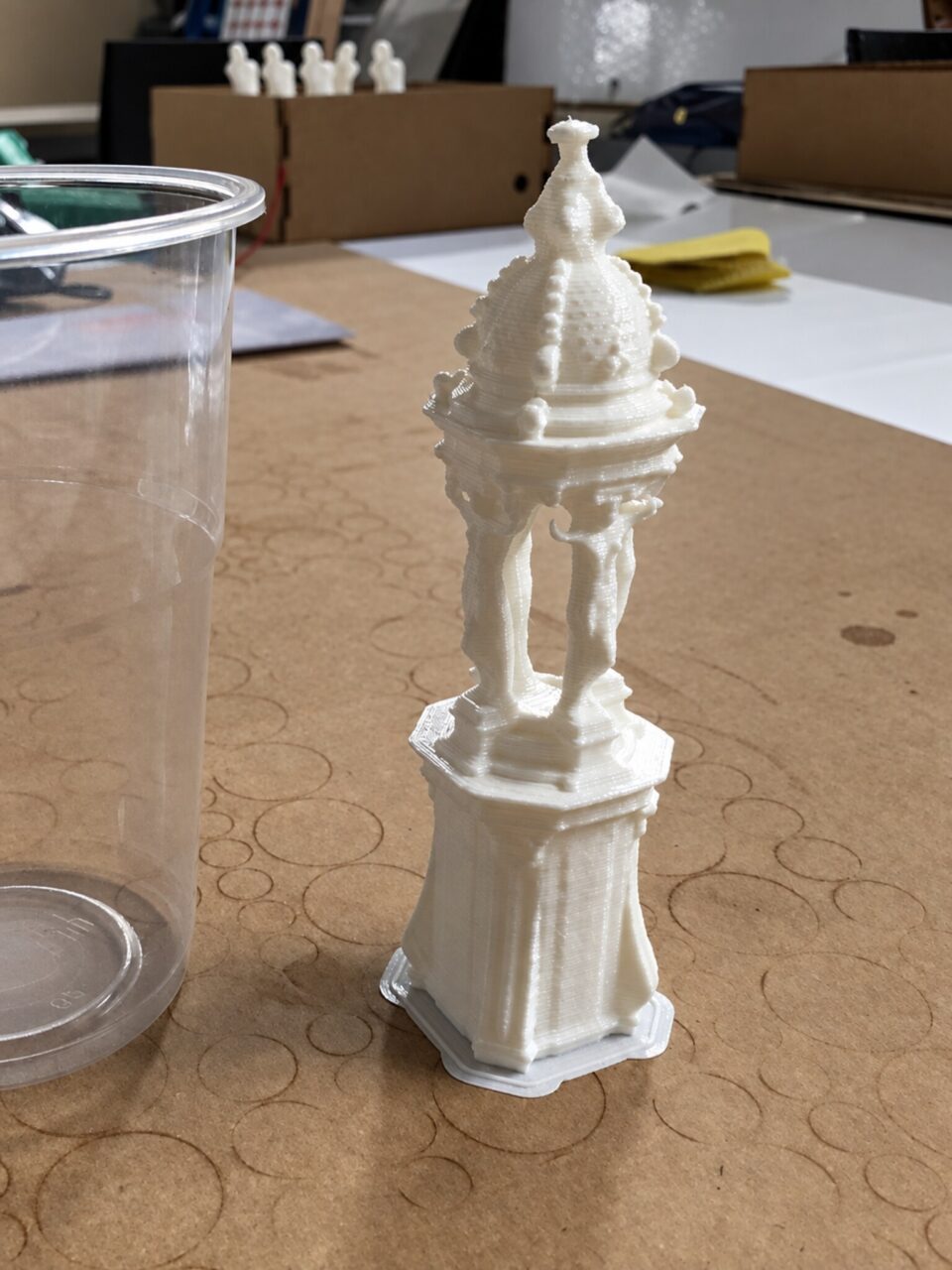
- An ornate monument, printed in miniature.
The Interface 介面
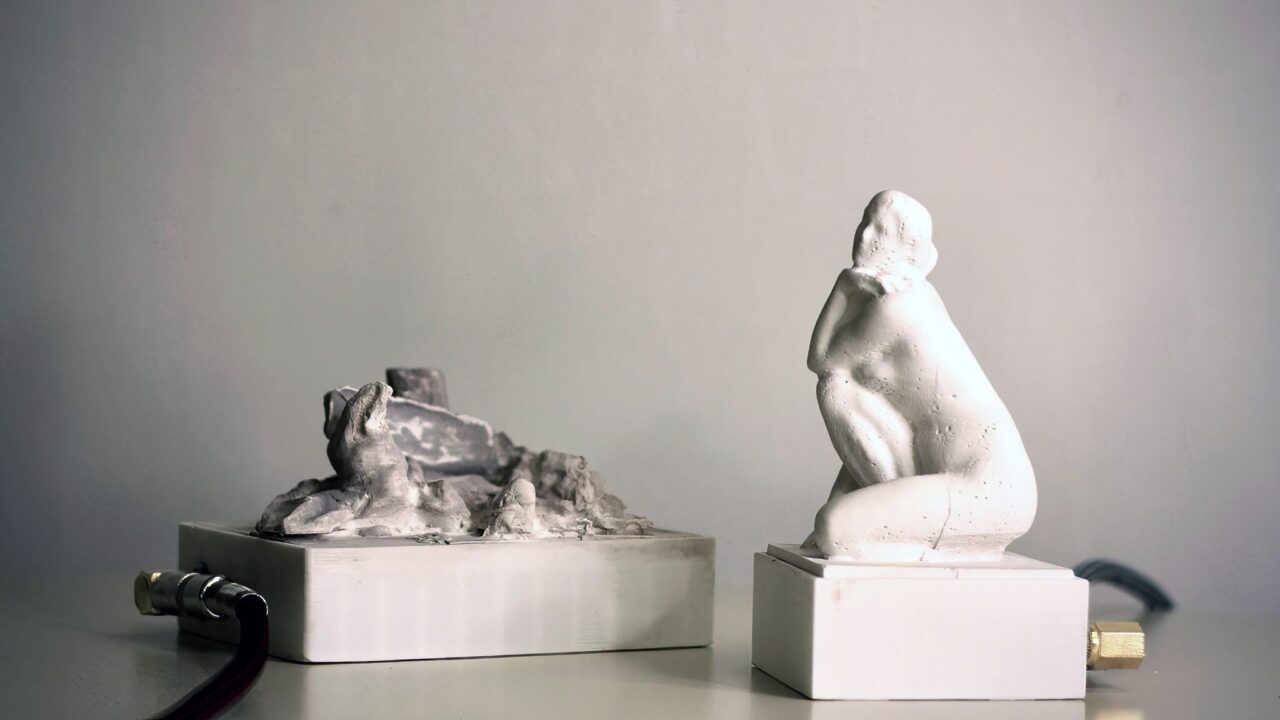
Sounding objects: casts with embedded contact microphones.
The sensing and pattern-recognition system was developed with Javier Villarroel. A contact microphone captures vibrations produced when a hand interacts with the object’s surface. Wekinator was trained to distinguish different gestures through these sounds, allowing tapping, dragging, and scraping on the same object to trigger different audiovisual materials.
A Max/MSP patch receives the recognized gesture and determines what is played, including sounds produced on the object’s surface, footage recorded at the scanning site, and streamed audio or video. Because each cast object retains a different geometry, its form also shapes the gestures through which it can be played.
感測與模式辨識系統由紀柏豪與 Javier Villarroel 共同開發。接觸式麥克風收錄手與物件表面互動時產生的振動,再以 Wekinator 從這些聲音中辨識不同的動作,使輕敲、拖曳與刮擦同一件物件時,能觸發不同的影像與聲音素材。
Max/MSP patch 接收辨識結果並決定播放內容,包括物件表面產生的聲音、掃描地點預錄的影像,以及網路串流的聲音或影像。由於每件翻模物件都有不同的幾何形態,它的形狀也會影響人們可以如何觸碰、摩擦與演奏它。
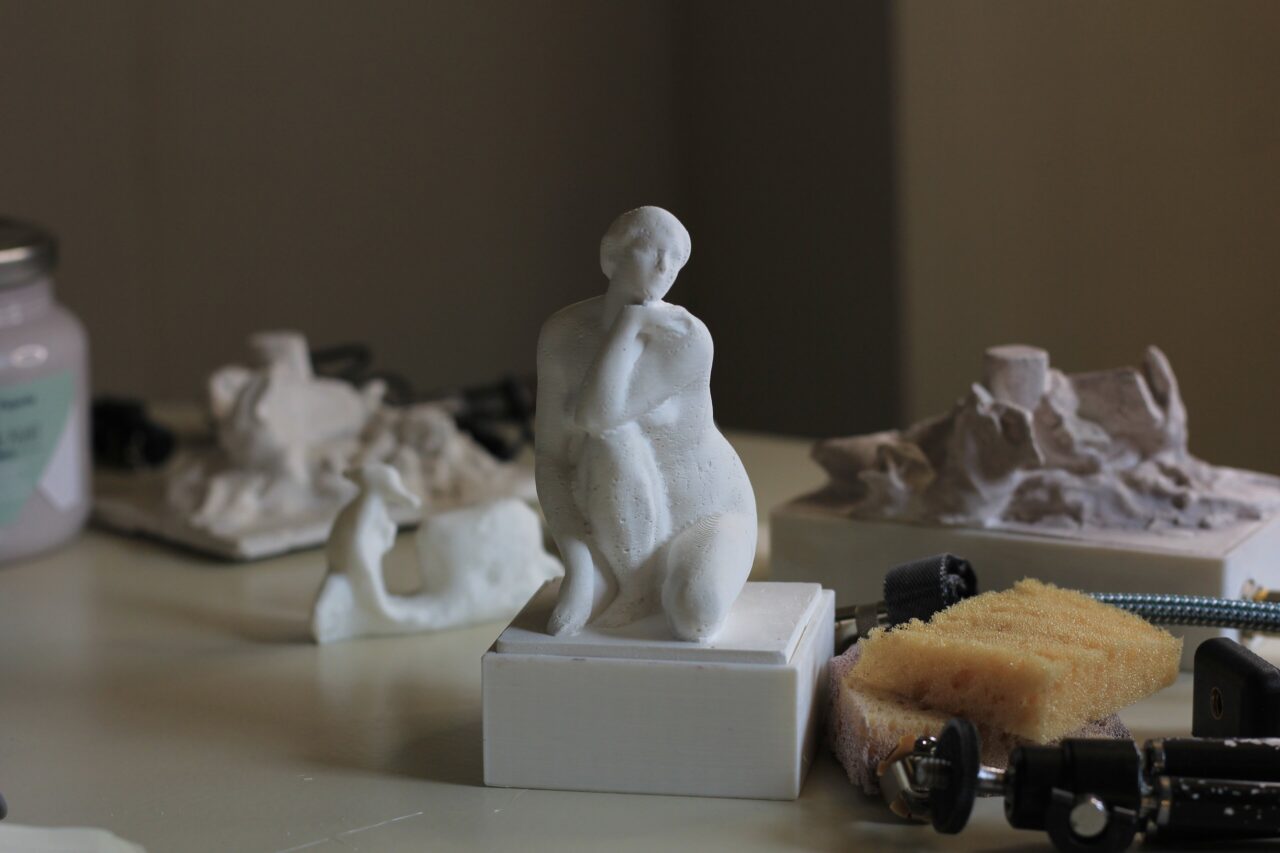
Prototype of the figure model and plinth interface.
Souveniring Almost Anything 如何紀念(幾乎)任何東西
📍 Medialab Prado, Madrid
🗓 June 24, 2021
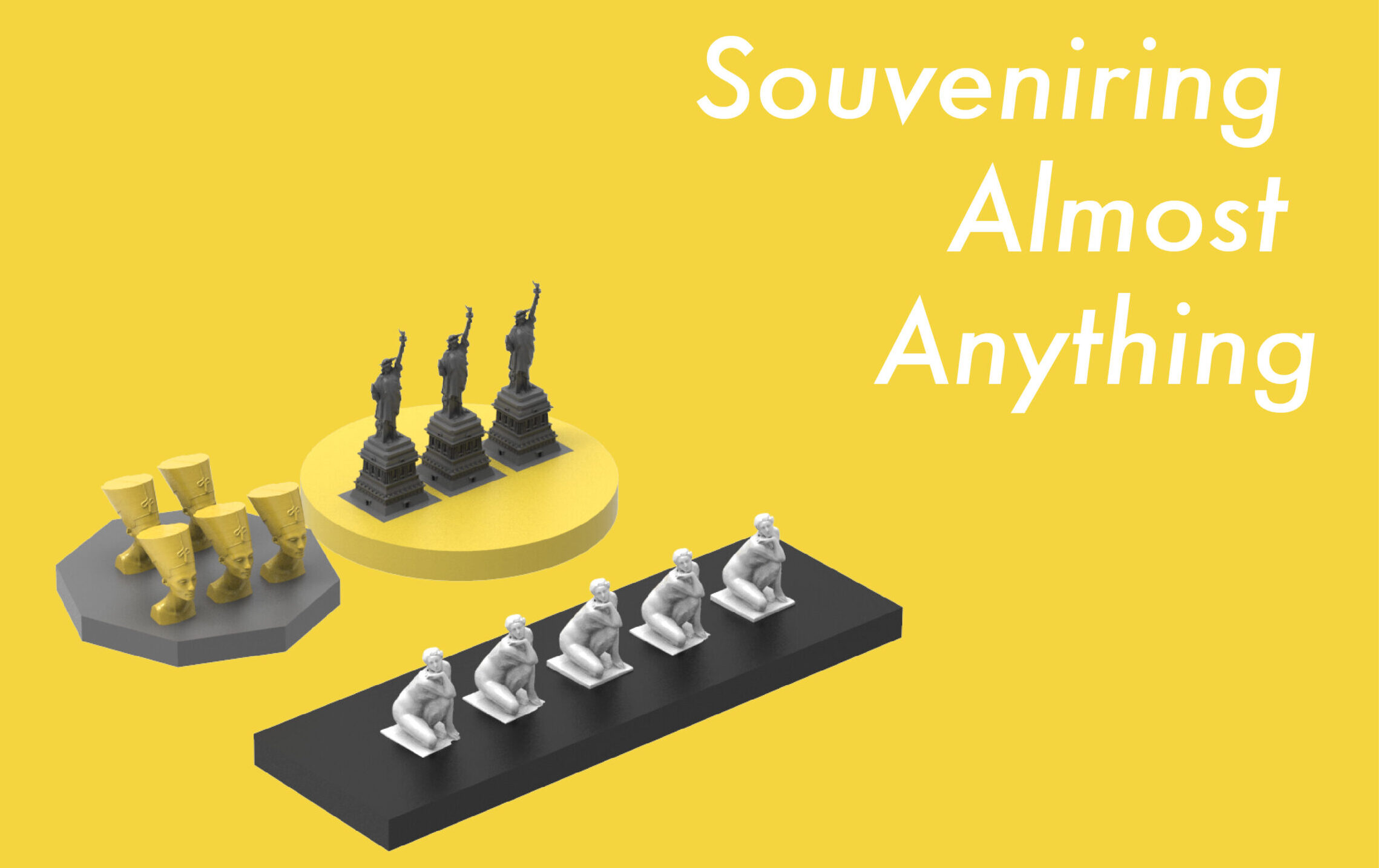
Visual for the Souveniring Almost Anything workshop.
Take whatever you have around you. Observe it, shoot it, record it. Scale it, rotate it, warp it. To shape our fiction using what we have in hands. To stitch gazes, montage memories, and collage entities, in this uncertainty. I give you mine. You let me take yours.
The workshop was held in person during the COVID-19 pandemic and brought together participants from varied backgrounds, including researchers, makers, students, and members of the public. After working through the basic photogrammetry process in Agisoft Metashape, participants went out into the surrounding neighborhood to scan objects and structures they encountered: a monument, a doorway, a fountain, and a sofa left on the curb.
The workshop approached phone-based photogrammetry as a form of digital craft. Producing a usable 3D model involves moving around an object, judging distance and image overlap, finding accessible viewpoints, and continually adjusting one’s position in relation to what is being scanned. The resulting model is therefore shaped by both the object and the path taken around it.
Afterward, participants were invited to contribute their models to a shared collection and add a short note about what they had chosen to scan. Carmen Torrecillas contributed a bone and a fragment of a garden, writing that she was drawn to what the technique could capture that a cube or sphere could not describe: the organic, the delicate, and the imperfect.
工作坊於 COVID-19 疫情期間以實體形式舉辦,參與者背景多元,包括研究者、創作者、學生與一般民眾。完成 Agisoft Metashape 的基本攝影測量流程後,參與者走進周邊街區,掃描沿途遇到的物件與構造,包括紀念碑、門洞、噴泉,以及被留在路邊的沙發。
工作坊將手機攝影測量視為一種數位工藝。要產生可使用的 3D 模型,需要繞著物件移動、判斷拍攝距離與影像重疊、尋找可抵達的視角,並持續調整自己與掃描對象之間的距離。因此,最後生成的模型同時受到物件本身以及人如何繞行與接近它的路徑所影響。
活動結束後,參與者受邀將自己的模型加入共享收藏,並簡短記錄選擇該物件的原因。例如,參與者 Carmen Torrecillas 提交了一塊骨頭與一小片花園的模型。她寫道,自己著迷於這項技術能捕捉、而立方體或球體無法描述的事物:有機、脆弱與不完美。
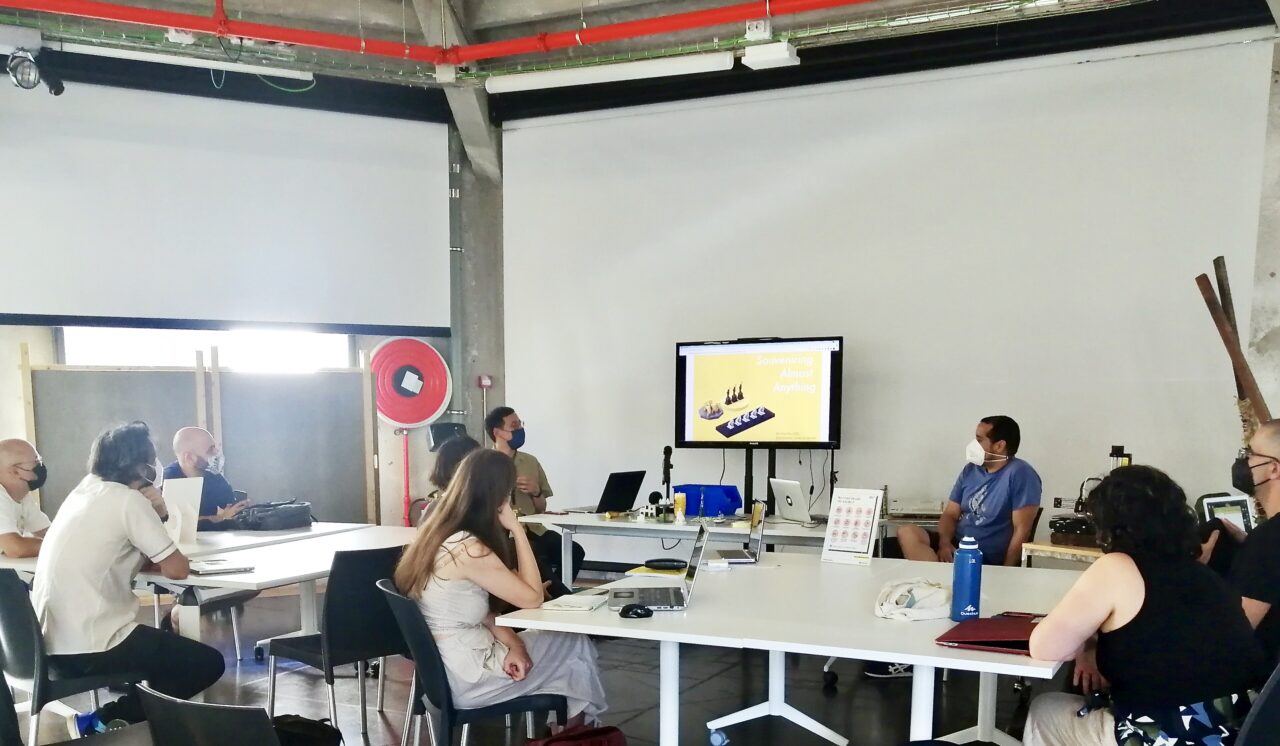
Souveniring Almost Anything, photogrammetry workshop, Medialab Prado, Madrid, 2021.
-
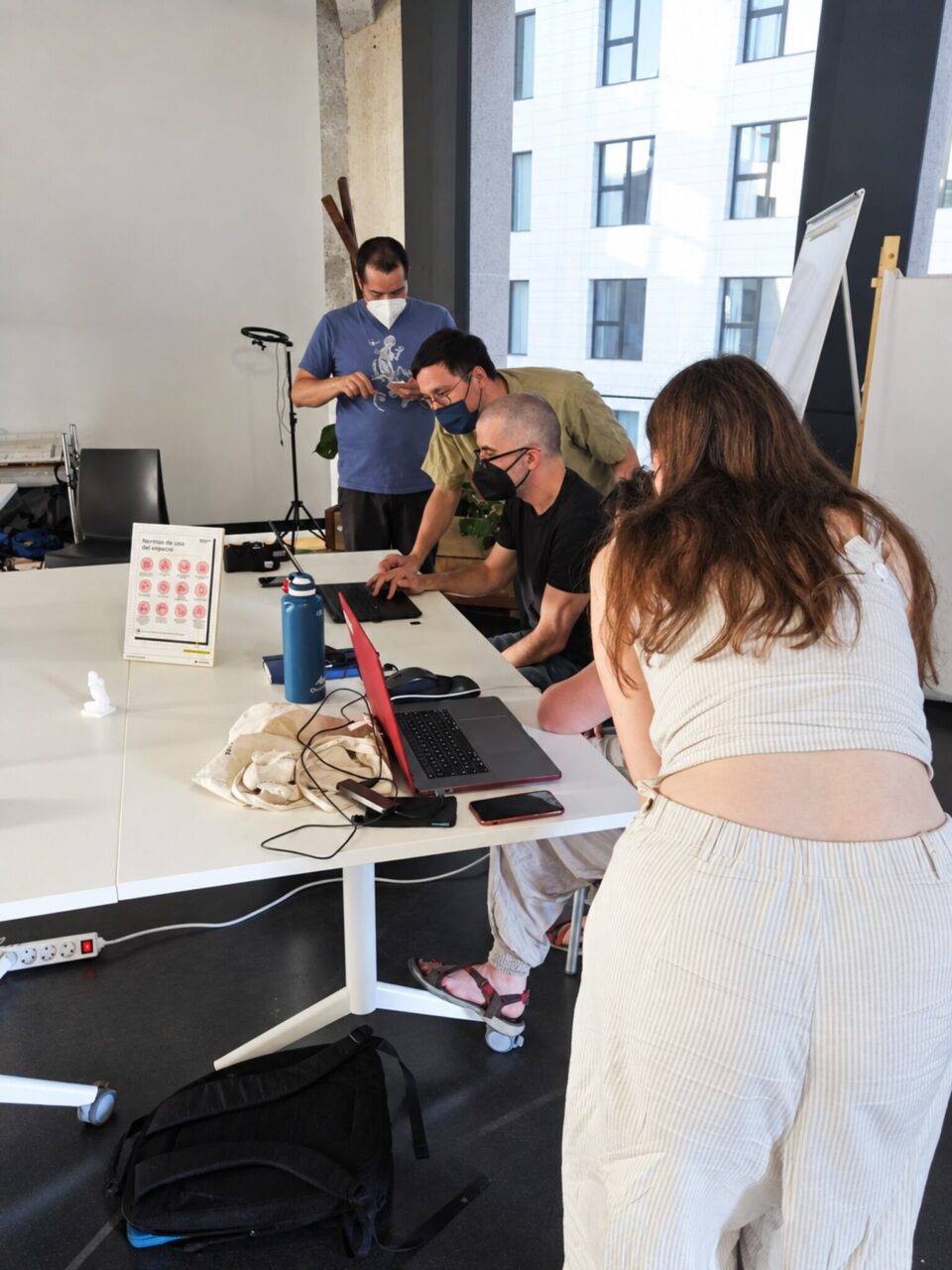
- Participants working together around one table.
-
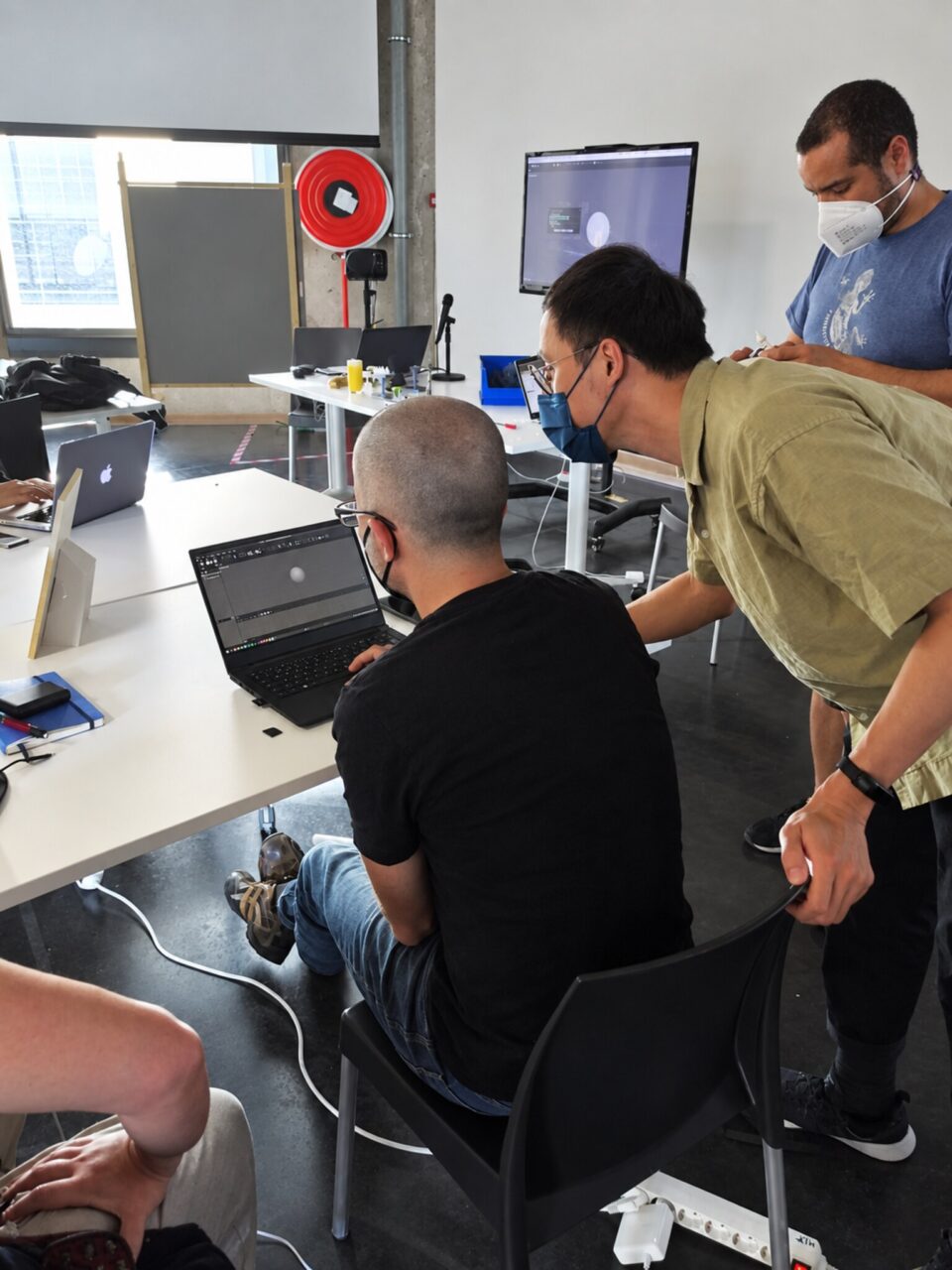
- One-on-one guidance in Agisoft Metashape.
-
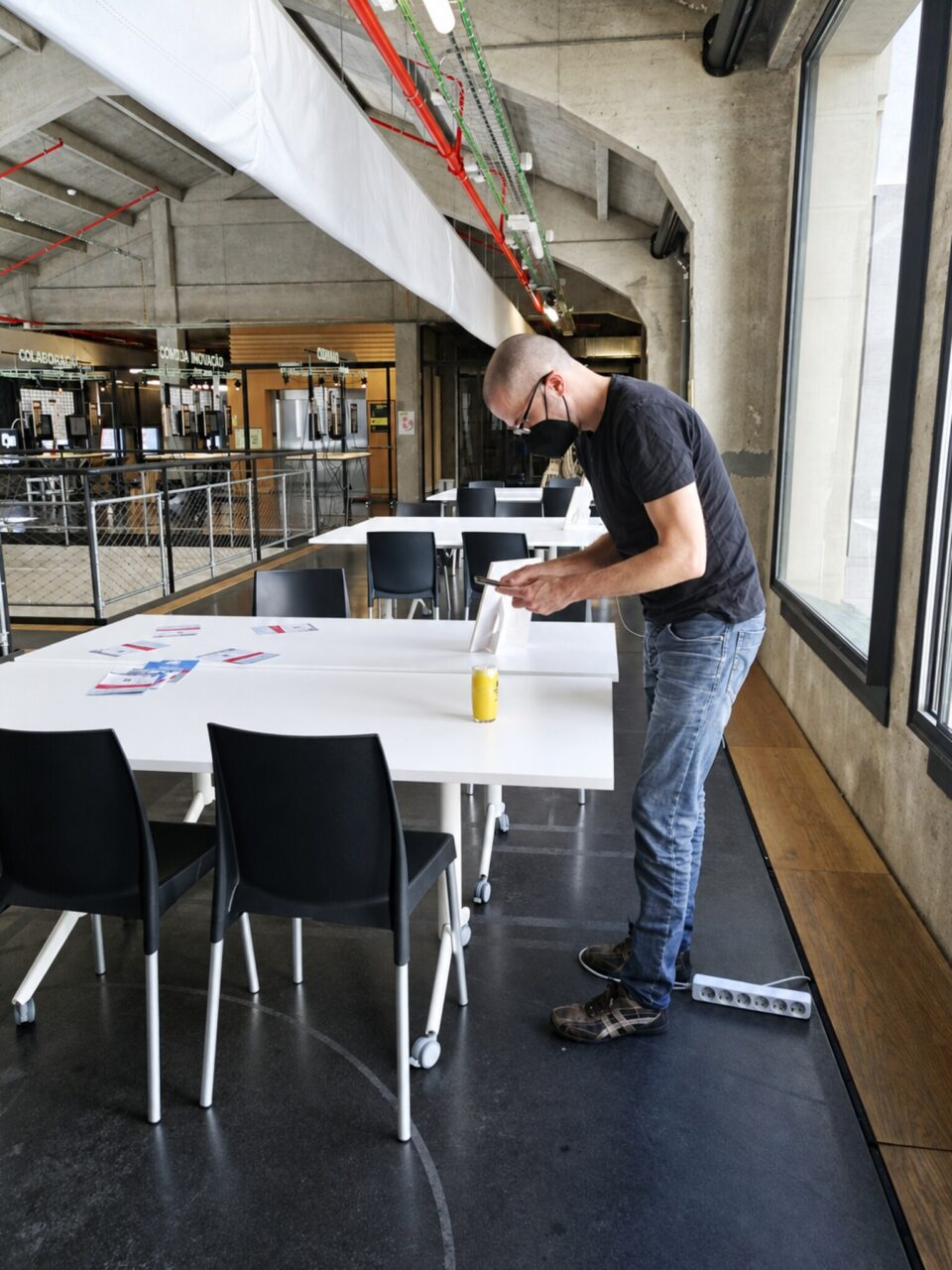
- A participant capturing a small object with a phone.
Final Residency Presentation 駐村成果發表
📍 Auditorio, Medialab Prado, Madrid
🗓 July 15, 2021
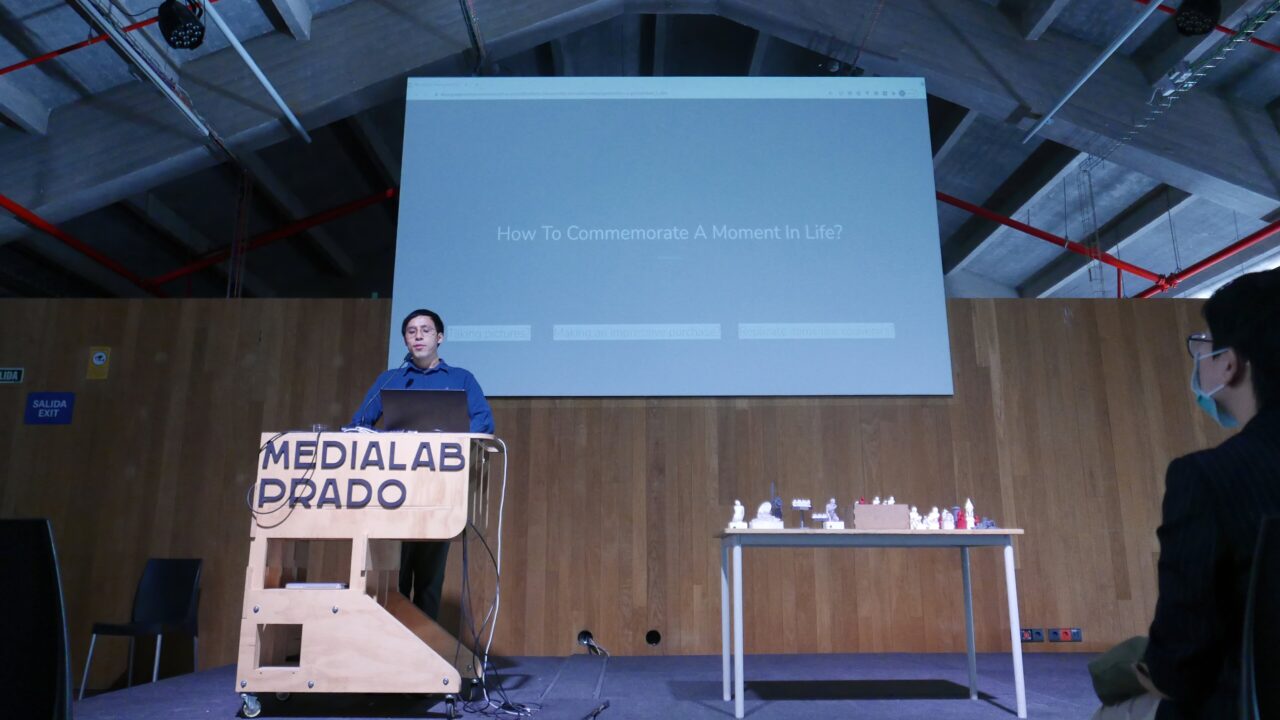
Collage of Hybridities, residency presentation, Medialab Prado, Madrid, 2021.
The residency closed with a public presentation at Medialab Prado, also streamed online. The talk traced the project from its opening question, how we commemorate a moment in life, to the workshop and the cast objects. A physical presentation of the objects, planned with the FabLab, was postponed when Medialab Prado relocated and reorganized.
駐村以公開成果發表作結,同時線上直播。發表從「我們如何紀念生活中的某個時刻」這個起點提問談起,再談到工作坊與翻模物件。原訂與 FabLab 合作的物件實體呈現,因 Medialab Prado 搬遷改組而延後。
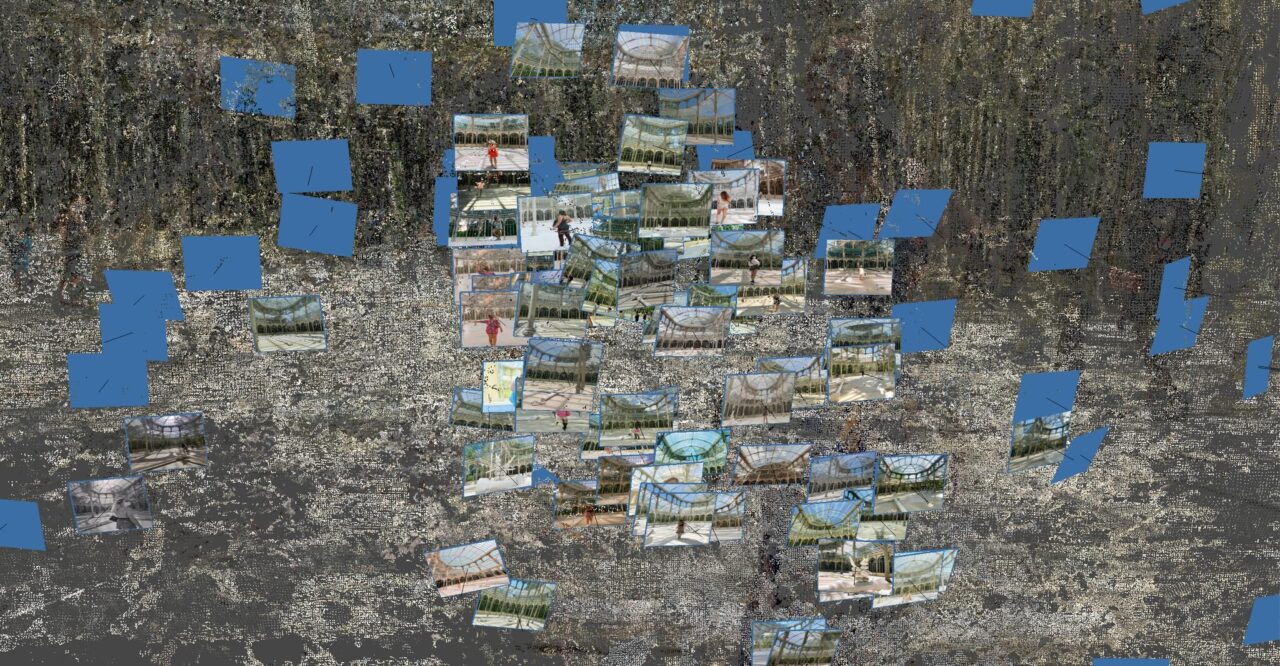
Point cloud of the Palacio de Cristal, Madrid, reconstructed from public Instagram photographs.
The talk also presented a modeling experiment that reversed the workshop’s method. A web crawler collected public Instagram photographs tagged at the Palacio de Cristal in Madrid, and the same reconstruction process turned them into a point cloud. The photographs were taken by people who did not know one another, at different times, and none were taken for scanning, so the model has no single author. Most were taken from a few similar spots under the glass vault, often with someone posing in the middle. John Urry and Jonas Larsen call this the tourist gaze: earlier images shape where people point their cameras.
發表中也展示了一個與工作坊方法相反的建模實驗,透過網路爬蟲蒐集 Instagram 上標註馬德里水晶宮(Palacio de Cristal)的公開照片,再用同樣的重建流程產生點雲。這些照片由互不相識的人在不同時間拍攝,沒有一張是為了掃描而拍,因此這個模型沒有單一作者。多數照片是在玻璃穹頂下幾個相近的位置拍的,畫面中央常有人擺著姿勢。John Urry 與 Jonas Larsen 稱之為「觀光凝視」,意思是既有的影像會影響人們把鏡頭對向哪裡。
Watch the full presentation on YouTube 觀看完整發表影片
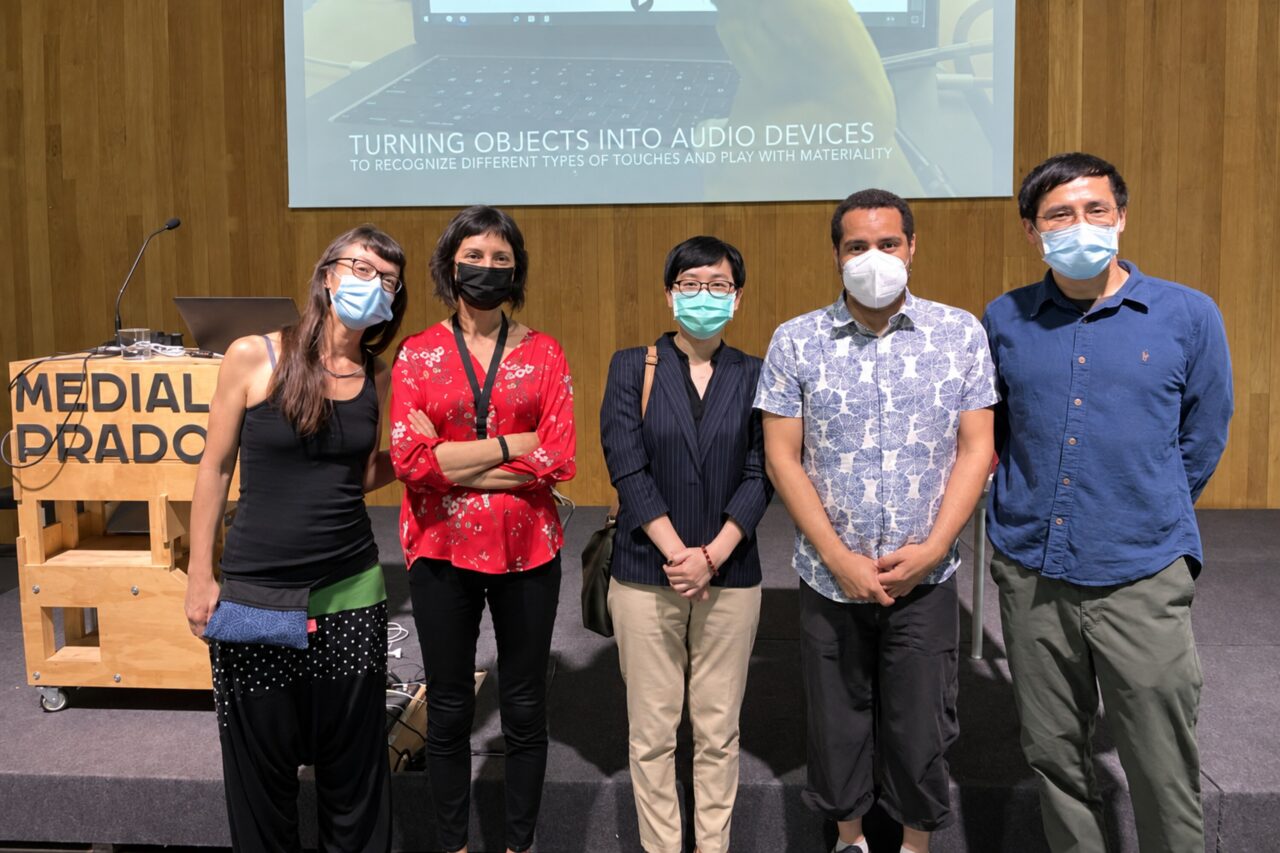
Group photo after the residency presentation. From left: Majo Castells, residency manager; Sonia Diez Thale, project lead; 張祐瑄, head of the Cultural Division, Taiwan representative office in Spain.
Press & Links
- Souveniring collection on Sketchfab
- Collage of Hybridities, Medialab-Matadero
- Final presentation of the residency, Medialab-Matadero
- Po-Hao Chi, Artist in Residence, Medialab-Matadero
- Presentación final de la residencia de Po-Hao Chi, Madrid Destino
- 虛擬世界中牽起人與人的連結 藝術家紀柏豪赴西班牙發表駐棧創作成果,中央社 Central News Agency
- 國立臺灣美術館新聞稿 NTMoFA press release
- 文化部新聞稿 Ministry of Culture press release
Related Works
- A Fictional Landscape of Togetherness 虛構的團結景觀, 2020. An earlier project supported by the MIT Transmedia Storytelling Initiative, in which collaborators in different locations scanned their surroundings with mobile devices and assembled the results into a browsable fictional landscape.
- Island of Afterglow 微光小島, 2025. Field activities in Hsinchu whose workshop also documented participants’ models through 3D scanning.
Credits
- Artist: Po-Hao Chi 紀柏豪
- Residency: Medialab Prado, Madrid, 2021 (the program later moved to Matadero Madrid and now operates as Medialab Matadero)
- Collaborator: Javier Villarroel
- Design support and consultation: Jenny Huang
- Residency coordination: Sonia Díez Thale (Medialab Prado), Majo Castells (Grigri Projects)
- Fabrication: Medialab Prado FabLab
- Workshop contributions: Models produced by workshop participants are included in the Souveniring collection on Sketchfab.
- Supported by: National Taiwan Museum of Fine Arts 國立臺灣美術館, MIT MISTI Spain